
Cradle Americans
On America's 250th birthday, a hard truth: a freedom you have never had to defend is a freedom you do not know how to defend.

Hi all,
There is a phrase in the Catholic Church for a certain kind of believer: the cradle Catholic. It means the one who was born into the faith, baptized before he could speak, raised inside the rituals so completely that he never had to choose them. He did not convert. He did not study his way in or have a come-to-Jesus moment that brought him to the church door as a grown man. The cradle Catholic was simply always there. And the church has a quiet worry about him, an insecurity, because the thing you are handed in the cradle is the thing you are most likely to take for granted. The convert had to earn the faith and so he knows exactly what it is. The cradle Catholic risks practicing out of habit a thing he has never once had to defend.
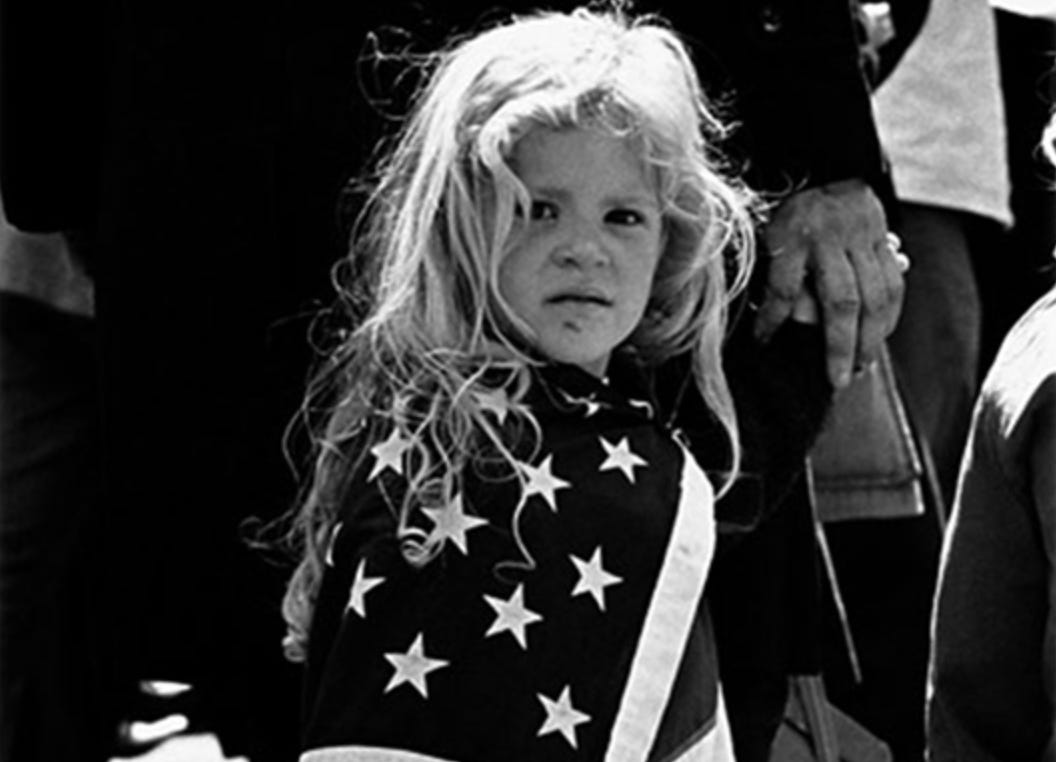
I have come to think there is such a thing as a cradle American, and that many of us now are one. We were born into freedom the way the cradle Catholic was born into the faith. We did not convert to freedom. Most of us under seventy did not serve in the armed forces or march for it or risk our families. We were born into this land where the rights were already written down and the laws made. And like the cradle Catholic, we are in danger of losing the greatest thing we have ever been given, because a freedom you never had to defend is a freedom you do not know how to defend.
This week America turns two hundred and fifty. For most of my life I have heard her talked about as a wound rather than a country, a place haunted by what she did before any of us were born. I do not believe that, and the reason I do not believe it is that my own family were not cradle Americans. They were converts. They came to American freedom the way the adult convert comes to the church, by choice, at cost, and with their eyes open.
My paternal grandfather was born to former slaves at the turn of the last century. He grew up dirt poor in segregation and he educated himself by reading every book he could find. As an adult, he marched in the Civil Rights movement for the full freedom denied to him because of his skin color. My white grandmother gave up a comfortable life in Ohio and when she married my grandfather in Chicago in 1942, she moved to his side of the color line and joined his quest for freedom. My father spent the first twenty years of his life in segregation. My other grandfather spent six years staying alive while Nazis and Ukrainians and Poles and Russians tried to kill him for being a Jew. On the Lower East Side of New York, my mother grew up in a depressed enclave of Holocaust survivors where she was expected to carry on Judaism and marry a Jew. She wanted to be a part of larger America and left the enclave for Iowa where she met my father. None of them was handed a thing. They chose America, and because they chose her they knew precisely what she was worth.
I am the first male on my father’s side to be born free of any government-sanctioned racial oppression, and who knows how far back the line of unfree men runs behind me in America. That is the inheritance my converts left me. I did not earn it. I was the cradle American they made possible. I grew up in freedom but do I and the millions of others like me know what I was given? Or do I only practice it out of habit? What is the value of a freedom that has not been suffered for?
To answer that I have had to think hard about what freedom even is, because we use the word as though its meaning were obvious and it is not. We talk about freedom as if it were a set of conditions out in the world, a thing the government grants or withholds, a thing that can be handed to us or taken away. But that is only the outer shell of it. The real thing is not out there at all. I have had the blessing of being surrounded by those who won their freedom while growing up, and one thing that always struck me was that they sought freedom even when their larger society denied it to them. My grandfather, who lived all but ten years of his life in segregation, always said he was a free man. My other grandfather, who was hunted down for six years in the Holocaust, survived because the impulse to be free was so strong within him, strong enough to give him life.
Freedom is the most existential of conditions, and it lives inside us. It is the condition that we as humans were born with, condemned to author our own life or to surrender it to someone else, to bet on ourselves or to wait for some magical world to redeem us. It is the natural law, and no manmade law can grant or revoke it. It is simply what it is to be a person, and it is the one possession that cannot be given to you, because the having of it is the using of it.
I have argued this for years, and it provokes people. I will say that even in the extremity of slavery, a person is not wholly unfree in the deepest sense, and they look at me as though I have lost my mind. Of course the slave is in bondage. The outer chains are real, degrading, and often unbreakable by the individual alone. Yet even inside that crushing constraint, a final choice remains, however cruel and however small: to run or stay, to submit or resist in whatever way one can.
We saw the same terrible truth in the Nazi death camps. Prisoners facing certain murder still possessed the one thing the guards could never fully confiscate: the manner of their dying. The inmates who rose up at Treblinka, seizing weapons and burning the camp even though almost none would survive, died in an act of freedom, and they knew it.
This does not lessen the evil of oppression. Tearing down the walls of true oppression is among the noblest things a person can do. But that fight itself begins with the freedom within us. My grandfather did not march because he was waiting to be handed his freedom. He marched because he already carried it within him, and marching was that freedom reaching outward to claim the world it deserved.
Which means the real question has nothing to do with how wide my space happens to be. Mine is the widest that anyone in my family has ever experienced. The real question is whether I will use the freedom within me or not. My grandfather was squeezed on every side by Jim Crow, and he used every inch of freedom that he had. He read every book he could find. He started side businesses, including a pesticide business, and made enough money to buy a car nice enough that he parked it blocks from work so his white boss would never see it. It was because the world tried to deny him freedom that he valued it and refused to surrender it. He exercised freedom in his private quarters and marched for it publicly to have it be applied equally to all Americans.
To fully embrace freedom is to be exposed, fully visible, flaws and all, no longer able to pretend that what becomes of you is somebody else’s doing. The inner freedom was always the real thing. But America is the rare country that also tore down the outer walls that stood in its way, which is why to waste the choice here, where nothing stands between us and it, is the deepest betrayal of the freedom my family proved was real even where everything stood against it.
The strangest thing about my lifetime is that far too many in this country with every freedom written into its laws have spent years insisting they are not free. After the great collisions of the 1960s, at the very moment we should have moved forward into freedom, many of us turned around and retreated into race and tribe instead. The laws were on the books and the doors were open or beginning to open and yet we still told ourselves the doors were shut.
While many builders and thinkers among us keep pushing the country toward what it has never been, many others have turned to face the other way, ransacking the past for someone to blame for every failure of the present. We have become a backward-looking people, and grievance has become one of our largest industries. The strangest part is what it did to freedom itself. A movement rose insisting that blacks and other minorities were not free, in the safest and most prosperous decades that any minority had ever known. And millions of whites were told that to defend themselves against the charge of racism was itself proof of racism. Many of them discovered that it was easier to go silent than to be brave, and so they surrendered their own voice. That is why the few who did speak out made the news. That is the quiet tragedy of my lifetime. Not that the country was evil, but that a free people, handed the widest liberty in human history, grew so frightened of a single accusation that they chose to give the freedom back. And a people that will not defend its freedom eventually stops recognizing it. It is why a great city can now elect a mayor promising the very socialism both of my grandfathers sought to escape, and call it progress.
And while we argue about the past, a black mayor in progressive Chicago presides over failing schools full of black children on the South Side, and those children go on failing. And elsewhere, school districts continue to lower the standards in the name of remedying the past.
The past is finished. It is far easier to go backward than forward—because the past offers certainty while the future demands risk, and risk exposes us to the possibility of failure. The backward-looking person has found a way to feel righteous while risking nothing.
And while we looked backward, too many of us fell silent. Not because they agreed, but because they were afraid, and of one word. They feared being called racist more than they feared losing the very freedoms their families marched for or crossed oceans to secure.
In the last sixty years, we have nurtured a society that lavishes its applause on the man who feels the right feelings loudly in public and forgets the man who quietly does the hard thing and asks for nothing. My grandparents asked America for nothing but the chance, and out of that chance they made everything. They made it against a world that told them no at every turn, and still they chose to be free. And that brings me back to us, the cradle Americans. We were born into the freedom they had to win. We did not earn it, and it is easy to forget that the one thing we share with every human before us is the freedom within us, an existential condition. It is our inheritance. And it is an inheritance that challenges us, and it is the hardest one there is because a freedom that costs you nothing is a freedom you can lose without ever noticing it is gone.
On the week the country turns two hundred and fifty, we Americans alive today are the freest human beings who have ever walked the earth. Not the freest Americans. The freest people in the whole long story of our species, with more liberty, more safety, more possibility, and fewer chains than any generation before us anywhere. I do not want to be the American who was handed everything and did nothing with it. I want to reach within, to the freedom my grandparents proved was real even in the narrowest of rooms, and actually live in it.
I have not always lived up to their gift of freedom. I have stayed silent when I should have spoken up. I have found my courage a bit too late. I will never be able to change the fact that I am a cradle American. But to name the condition of my existence is to use the one freedom I do have: to hold myself accountable to the freedom within me.
That is the whole of it. Not to apologize for this country and not to flatter it, but to become worthy of the freedom that America makes possible, by having the nerve to use it. My grandparents made that choice against everything. I have been handed it with nothing in my way, and so have many of us. The only question left is whether we are still the kind of people who will use it and honor it.
My best,
Eli
“I do not want to be the American who was handed everything and did nothing with it.”
Love this!
Your family history makes your life a walking indictment of identity politics. Your story is moving and stirred my heart. I do not have a history like yours. I have lived my life taking these freedoms for granted, in many ways, not even aware of them. Perhaps it is time for us to rise out of our cradles and fight for our freedom before it is gone. Thank you for entering the battle. Your work is very valuable.