
The Cambridge Fabulist
The examination of the evidence itself became the crime.

Hi all,
A journalist wrote an email to a professor at Cambridge University and asked if his doctoral thesis contained sentences that were not his own, and this question resulted in the UK’s Metropolitan Police investigating the journalist.
That is the sentence right there. Everything within this sentence happened and there is no logic to it. The illogic is the point in this age of white guilt, one that reveals the next floor in our society’s decline.
The targeted professor is Jason Arday who was celebrated in 2023 as Cambridge’s youngest black professor ever. He specialized in the sociology of race, inequality, and education and is known — ironically — for his study on how institutions fail black people.
The Times Higher Education journalist, Jack Grove, investigated a claim that Arday’s doctoral thesis contained sentences that were not his own. The inquiry was simple: did you write these words or did someone else? This line of questioning is race-neutral.
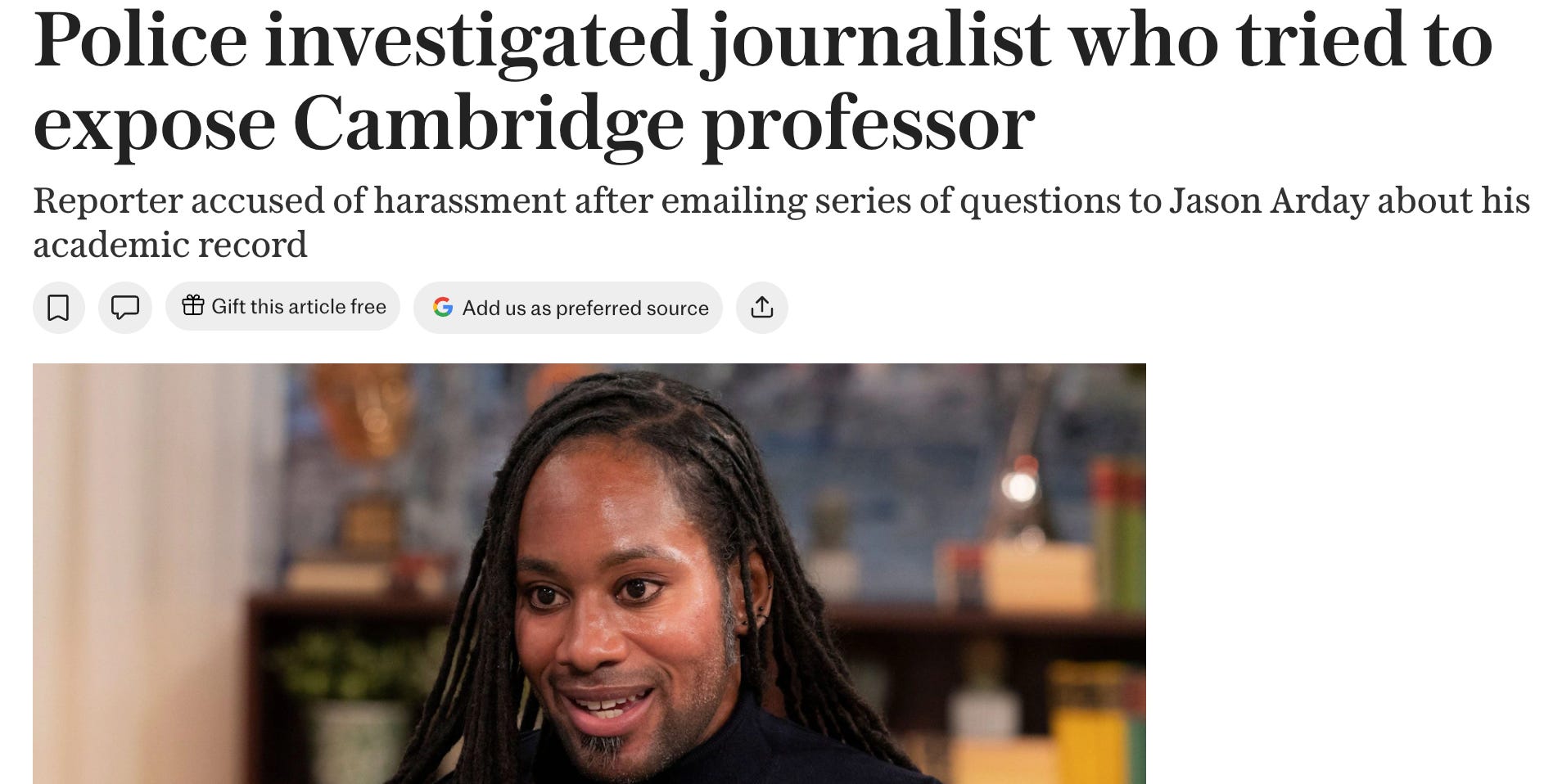
It is important to keep in mind that, as of now, the facts of this case remain contested. Cambridge insists that they cleared Arday of any wrongdoing. Liverpool John Moores University, where Arday’s doctorate was granted, says that the thesis stands. Arday himself denies all plagiarism accusations, including the allegation that his 2015 PhD thesis contains over 180 passages identical or near-identical to the 2009 thesis by Paula Zwozdiak-Myers of Brunel University. However, my interest in this story goes beyond the plagiarism question to what happened when a journalist asked a legitimate question.
When Arday received the email from Grove in September of 2025 he was given the customary courtesy to respond. Grove did not get an answer. He got a letter from Carter-Ruck, a law firm retained by Arday, and they told Grove that his inquiry may have been racially motivated. The Times Higher Education killed the story shortly afterward.

This is white guilt. The charge of racism was leverage. The response was to retreat from that stigma out of fear.
Then, in November, the Metropolitan Police received a complaint of harassment against Grove who was never told who made it. The police proceeded to investigate Grove for four months and not once did they interview him. When the police finally called Grove, they told him to cease the harassment and leave the professor alone because his mental health was being affected.
The journalist had asked the professor if he plagiarized sentences and why did the police get involved? The short answer is because the journalist’s inquiry had been converted by the law firm’s letter into an act of harassment on racial grounds. Harassment was the charge here. In a world that even Kafka would have had trouble imagining, Grove stood accused of being a racist.
My father, Shelby Steele, has spent much of his life describing white guilt and the genius of this power is that it never has to argue. It only charges racism. It makes no offer to review and pick apart the evidence — did Carter-Ruck do that? — and it makes the examination of the evidence itself the crime. Arday’s black skin in this culture of victimization gave him the power to flip the script on Grove and the accused became the accuser. And the terror of being seen as a racist strikes fear in the newly accused. Grove had committed the sin of asking the question of a black man who reached not for merit but the charge of racism in response.
It is important to note that Grove and Arday did not act by themselves in a vacuum, but in a world heavily conditioned by white guilt. Cambridge raced to the defense of Arday and called the questions a “vile campaign.” The British police did not interview Grove, likely because his testimony would have complicated the ongoing narrative. These white guilt institutions chose the false innocence that came with the narrative, and they did so at the cost of the university abandoning its pledge to academic excellence and the police abandoning its pledge to justice. They would not challenge a man because his skin is black

This flareup did not happen overnight or come out of nowhere. Arday has been a protected man for a long time. Long before the plagiarism question, Arday’s public profile had reached and even surpassed the kind of status reserved for legends like John Henry and his hammer. He claimed he didn’t learn to read and write until he was 18 years old. He claimed that he had raised 5.5 million pounds for more than seventy charities. He said he ran six hundred miles in six days. To that, he added thirty marathons in thirty five days and claimed he ran the last nine on a broken leg. Also, he claimed that he was on a professional soccer team. In a video that I watched, he claimed that he was in the television series Seven Up, an excellent documentary that followed their subjects every seven years. The problem was that the subjects were born in 1957, three decades before Arday. When these stories came under scrutiny, Arday began to change his answers.

Personally, I couldn’t care less about Arday here. If anything, he’s a kind of a victim here, though one that bears tremendous responsibility for his actions. I say victim, because his stories and the work that he did went without rigorous examination that one would expect of a top school like Cambridge. They did so because Arday is black and to check their diversity poster boy’s story would run the risk of them being charged with racism. The whites wanted their innocence however false it was.
And it is these whites who claim to care about “black excellence,” and that is the cruelty here. When Cambridge shielded Arday from the kind of scrutiny that nearly all professors face, they did not defend the remaining integrity of academia. Instead they only confirmed the ugly stereotypes that is whispered about black scholars — that they cannot do the work and that the bar must be lowered. This is the price that blacks who chose the path of merit must pay for the cowardice of the weak who play the black power—white guilt coin. Arday will likely keep his position and social justice will be served. Grove asked a question, and paid for it. So did every black scholar along with their like-minded peers who earned their place the hard way.
My best,
Eli
I don’t blame Arday at all for following the incentives and taking advantage of the jobs, money and worship that was laid at his feet.
Black people under the white liberal dispensation of upscale academia are treated like holy children, similar to how the Tibetans treat the newest Dalai Lama. Progressivism is rooted in white guilt and saviorism and this provides not only sacred beliefs but morals, etiquette, status and a giant class marker that separates the Good guilty liberal from the Bad bigoted conservative. Progressives so deeply need to perform their public rituals of racial atonement, and are so constantly anxious about always being a proper ally, that they are the easiest of marks, essentially begging to be fleeced as long as it gets them an official dispensation from the Church of Social Justice.
Just think of all the white liberals who this man met on his journey to Cambridge and how they fawned over him, how they’ve been conditioned to exercise zero skepticism toward any claims made by a POC (which codes as gauche and taboo) and how thrilled they felt giving him a job or a promotion. The Academy has essentially politicized and sacralized tokenism, if not totemism, meaning how righteous and holy white liberals feel when they can be seen performing allyship. In this case the fault lies mostly with the marks not the con man, as they’ve created a system that incentivizes fraud and don’t really care or see it as a bad thing—our white saviors want to save their souls first and foremost, and academic standards or honesty only get in the way.
Ketanji Jackson Brown’s senate confirmation hearings were in this similar fashion. The number of times the Democrats intervened during questioning to literally silence her into not answering was something to behold.
This sort of behavior from Chuck Schumer, et al didn’t surprise me. It was her apparent willingness to sit there and allow them to disrespect and undermine her authority that got to me. I didn’t know who I was more disgusted by. The senators who had chosen a person they knew didn’t have the capability to sit for such a powerful position or the person chosen who didn’t speak up for herself and prove she was capable.